












Dan Firmager ACA
- ESG Advisor
- +44 (0)330 124 1399
- Email Dan

The 2026 Kreston Academies Benchmark Report reveals a sector achieving improved financial performance, but one where environmental progress has stalled.
Intensifying capital pressures and several recent policy decisions are making climate action for academy Trusts harder.
The findings suggest that climate and sustainability risks are now material operational risks, and the route to progress, at least in the short term, lies in influencing behaviours that change an established culture together with the smarter use of existing resources.
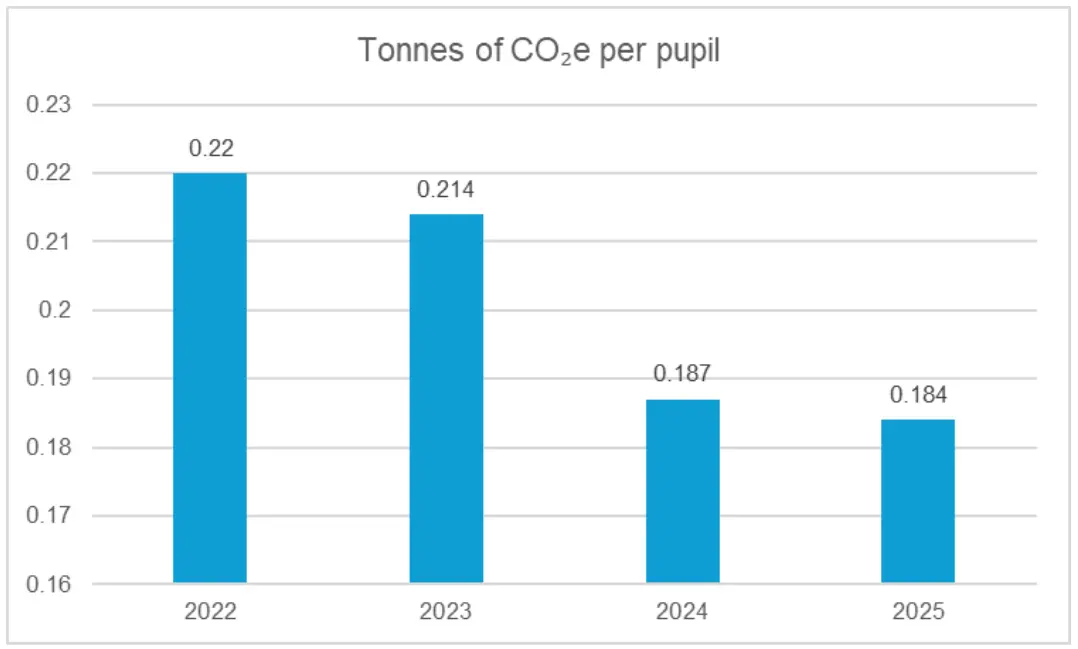
The report shows that almost all Trusts now sit within 0.1 to 0.3 tonnes of CO₂e per pupil, and Trust size has little impact on emissions. Critically, progress has stalled, with CO₂e per pupil in 2025 broadly unchanged from 2024. This is despite there being a 14% reduction in the official emissions factor for electricity as the UK grid transitions to renewables. It is likely, therefore, that energy usage by Trusts has in fact increased.
Trusts did benefit from a 13.7% fall in energy costs, driven by contract price resets rather than behaviour change or efficiency gains. CO₂ data confirms that usage has not meaningfully decreased, meaning cost reductions cannot be mistaken for environmental progress.
This creates a risk that perceived savings mask underlying estate inefficiencies. Trusts can only determine the truth by tracking and measuring, something smaller Trusts can find challenging.
Climate risk continues to increasingly feature on Trust risk registers. This is a sensible approach given increasing expectations for climate action from a public and regulatory perspective, energy efficiency, and the need for climate resilient estate management.
There are two key policy shifts creating barriers for Trusts, and a third that is making it harder for smaller Trusts.
Capital for heat decarbonisation and energy efficiency work has effectively disappeared. A disappointing amount of earlier funding was returned unused because projects were not financially viable, due to implementation costs.
This restricts access to a major low carbon staff benefit normally used to accelerate Trust-wide sustainability programmes. Removing barriers to such schemes would be welcomed by Trusts.
Only large MATs with School Condition Allocation (SCA) have predictable annual capital funds. SATs and small MATs remain reliant on the lottery of CIF bids, limiting their ability to plan long term improvements. Together these constraints create what is effectively a capital bottleneck. Trusts are expected to do more on climate while receiving fewer of the tools needed to deliver.
Perhaps unsurprisingly, ageing buildings together with insufficient capital funding for proactive building and maintenance are concerning risks for Trusts. Many are facing compounding issues:
There is some reassurance to be offered though. This year is the first time the new school condition survey reports have been considered in calculating SCA, and as a result some Trusts saw their SCA allocations double.
With major decarbonisation funding no longer available, the report’s data points toward one lever fully within Trust control – culture and behaviour.
Given the gap between ambition and capital availability, every Trust should now have a Climate Action Plan (CAP), as recommended by DfE. It is widely believed that behaviour change alone can reduce energy usage by around 10%. This is also the opportunity for schools to think beyond the immediate impact they can have in their own Trust and think about the systemic change they can have over time. Creating a culture of consideration for the climate amongst pupils will lead to a more climate conscious generation in the future.
More information on setting a sector leading CAP can be found here.
The sector is at a crossroads. Financial performance has arguable improved, but environmental progress has not. Capital constraints will continue but Trusts still have powerful levers available to them.
Trusts can drive meaningful impact by:
Capital investment will eventually return, and those Trusts with a plan ready to go may be prioritised. Culture change can start now, and its impact will reach far beyond the school gates.
We provide specialist ESG support tailored to individual Academy Trusts, focused on practical action, clear reporting and a Trust‑wide impact. Examples of the specialist work we can provide include:
We help Trusts or individual schools within Trusts create focussed Climate Action Plans that drive behavioural change and embed sustainability across pupils, staff, parents and governance. This includes establishing straightforward measurement and reporting of carbon and environmental impacts, an engagement plan for mobilising your stakeholders and governance reviews and recommendations.
We can provide full support with Streamlined Energy and Carbon Reporting, including data collection, compliant disclosures and clear analysis. Saving leadership teams time, ensuring reporting is ready for input into the financial statements.
Bespoke dashboards giving each school within a Trust clear visibility of its energy use and carbon impact, enabling local ownership and Trust‑level oversight.
To get help with developing the ESG efforts for your Academy Trust, please contact us today. We can discuss your circumstances in more detail and share our detailed Carbon Reporting Tiered Offering document.
Share this article
This site is protected by reCAPTCHA and the Google Privacy Policy and Terms of Service apply.
Related people

This site is protected by reCAPTCHA and the Google Privacy Policy and Terms of Service apply.
This site is protected by reCAPTCHA and the Google Privacy Policy and Terms of Service apply.

This site is protected by reCAPTCHA and the Google Privacy Policy and Terms of Service apply.
Our complimentary newsletters and event invitations are designed to provide you with regular updates, insight and guidance.
You can unsubscribe from our email communications at any time by emailing [email protected] or by clicking the 'unsubscribe' link found on all our email newsletters and event invitations.
This site is protected by reCAPTCHA and the Google Privacy Policy and Terms of Service apply.